Atlas Fit
A local-first training app built around a simple conviction: personal data should live on the person's device, and the plan should still work when the network does not.
- Core operating mode
- OfflineNo account or backend required
- Data ownership
- LocalProfiles and logs stored on device
- Plan generation
- DeterministicSame inputs produce the same plan
- Development status
- ActiveStill being built and tested
Atlas Fit is an offline-first fitness and workout-planning Progressive Web App. It is designed for the ordinary conditions of training: a phone in hand, an unreliable connection, and a preference not to hand a personal training history to a server.
The project is under active development. This page documents what exists, what it is built on, and what is still being worked out.
Overview
The app generates a training plan from a small set of user choices, then supports the session itself — viewing the plan, logging sets, and tracking progress over time. It includes home, gym and travel profiles so the same training intent can adapt to different equipment and environments.
Everything essential is local. There is no account system, no backend and no analytics dependency. The exercise library and muscle-focused artwork are bundled with the app so the experience survives going offline.
The problem
Most training apps are built as thin clients over a server. That architecture brings account screens, sync conflicts and a hard dependency on connectivity. For a personal training log, most of that is unnecessary. The data is small, private and only useful to one person.
The design question became: how much of a serious training app can be built with the device as the source of truth?
A second, subtler problem was trust. A generated plan is only useful if the user can understand why it looks the way it does. A deterministic generator — where the same profile and preferences produce the same plan — makes the system inspectable in a way that a hidden recommendation engine does not.
Approach
The app is shaped around three principles:
- Offline first, not offline as a fallback. The core flows are designed to work without a network. Persistence is local by default.
- Deterministic by design. Plan generation is a function of explicit inputs, not a random or remotely tuned process. The result can be regenerated and reasoned about.
- Quiet interface. Training is the task; the app should not compete for attention. The UI keeps the current set, the next action and the relevant history close at hand.
The workout profiles — home, gym and travel — change the available equipment and exercise selection without changing the underlying structure of the plan.
Architecture
The stack is deliberately conventional on the client and unconventional only where the local-first requirement demands it:
React + TypeScript
        │
        ├── Vite build
        ├── Tailwind CSS + shadcn/ui
        ├── Dexie → IndexedDB
└── Service worker / PWA install- React and TypeScript provide the component model and the type safety that keeps a growing data model manageable.
- Vite handles development and production builds.
- Tailwind CSS and shadcn/ui provide the visual primitives without importing a heavy design system.
- Dexie wraps IndexedDB with a queryable, versioned local database. Profiles, plans, logs and exercise data persist on the device.
- A service worker caches the application shell and bundled assets so the app can launch offline.
There is no server-side rendering layer, no API and no synchronisation service. That removes a class of failure modes, but it also means the app has to solve migrations and data durability locally.
Development
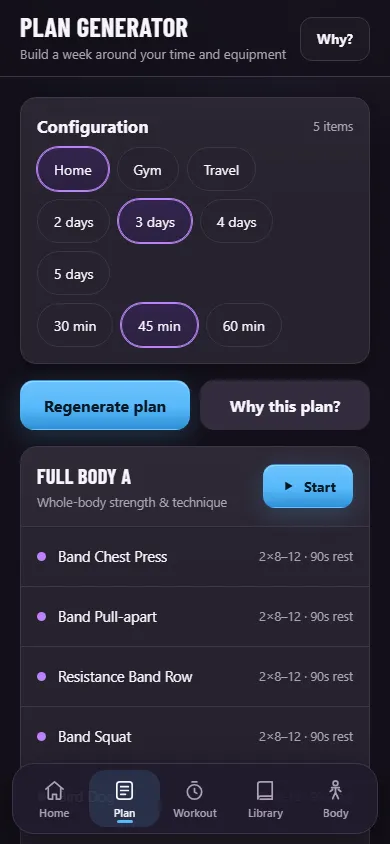
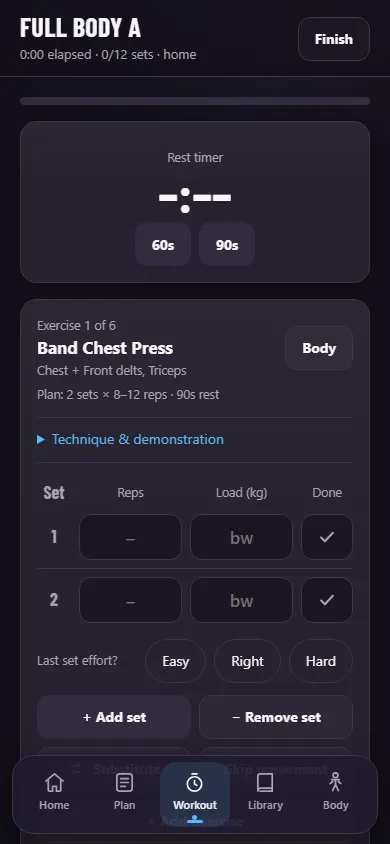
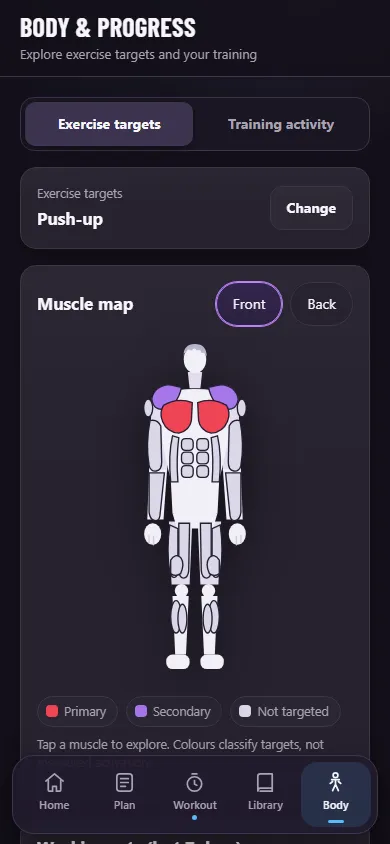
The build has been driven by using it. The mobile QA screenshots on this page come from the real application, not a mockup: the plan view, an in-progress session and the body view with muscle-focused exercise artwork.
Several implementation details took more thought than the features suggest:
- Plan generation as a pure pipeline. The generator takes a profile and preferences and produces a structured plan. Keeping it deterministic makes the output testable and prevents the interface from becoming a slot machine.
- Local data migrations. IndexedDB schemas change. Dexie’s versioning helps, but the app still has to treat a user’s existing log as data worth preserving.
- Exercise media. Exercise images and the muscle map need to be available offline without turning the install into an enormous download. Bundling and sizing were treated as product decisions, not afterthoughts.
- Mobile ergonomics. Logging a set happens with one hand, mid-session. The interaction has to tolerate imprecision and recover gracefully.
What works today
The current build includes:
- A local profile and preference setup.
- Deterministic generation of a workout plan.
- Home, gym and travel training profiles.
- A workout session view with set logging.
- Progress tracking built from logged sessions.
- A searchable exercise database with bundled imagery.
- Muscle-focused exercise visualisation.
- Offline operation and installable PWA behaviour.
A live build is available at atlas-fit-iota.vercel.app and the source is on GitHub.
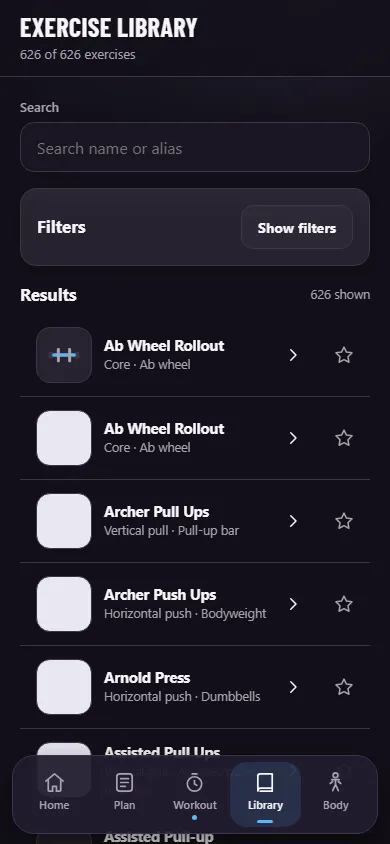
Screenshots from the live build, not mockups. The interface is still being revised as the project develops.
Limitations and next
Atlas Fit is not finished, and I do not want this page to imply otherwise.
- Testing is still narrow. The app has been exercised on a small number of devices and training routines. Broader device coverage and edge-case testing are ongoing.
- The plan generator is only as good as its rules. Deterministic output is inspectable, but it is not personalised by a coach. The quality of the exercise selection depends on the catalogue and the constraints I encoded.
- Local-first has a cost. There is no automatic cross-device sync. A lost device means lost data unless a backup exists.
- Content and polish are in progress. Exercise coverage, onboarding clarity and the finer states of the logging flow are still being refined.
The next phase is less about adding surface area and more about making the existing loop dependable: plan, train, log, review, repeat.
Reflection
Atlas Fit has taught me more about software architecture than any isolated tutorial. Local-first is not a feature you bolt on at the end; it changes where state lives, how errors are handled and what the user is promised.
It has also clarified what I want from the things I build: they should be useful without being noisy, and they should leave the person using them in control of their own data.